General information
Cheat Sheet
Before you dive into our prices section, we decided to provide you with a tiny cheat sheet. As we live in the digital age, vast majority of young photographers never put their toes into analog waters. So we in Negatiff thought that the following information might be useful for those who wants to try shooting something other than 0’s and 1’s. As a reference to the tables below we would like to show you how 120 film and 135 film look like. For more information about film formats please refer to F.A.Q. section of our site
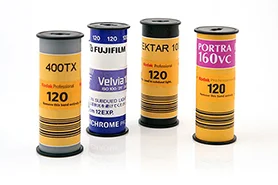
120 film type
120 or medium format film is so called because it is larger than 35mm or 135 format film, but smaller than 4×5 sheet film, which is called large format.
120 film usually comes wrapped around a plastic spool, and yields 12 or 16 images, depending on which camera and film masks you use. The terms “120 film” and “medium format film” are pretty much interchangeable nowadays, but it is important to know that the film is not 120mm. Medium format film does require a bit of special care in that it must be processed and printed at a professional photo lab – most drugstore or one-hour labs will not be able to process 120 film of any kind.
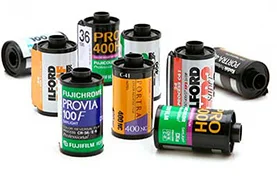
135 film type
135 or 35mm film is the most common photographic film format. The film is 35mm wide, and each standard image is 24×36mm. Individual rolls of 35mm film are enclosed in single-spooled light-tight metal canisters. This allows cameras to be loaded even in broad daylight. The end of the film is cut on one side to form a leader so that it is easy for the film to be inserted into a corresponding slot in the camera’s take-up spool. 135 format film comes in both positive and negative, black and white, color, and infrared. Color negative 35mm film can be processed at a drugstore or one-hour lab. 35mm black and white, color slide, and infrared films must be processed at a professional lab.
File types
We provide scans in the following file formats:
-
JPEG (.jpg) files (available in all resolutions listed in “Scan sizes” section)
-
TIFF (.tiff) files (available in all resolutions listed in “Scan sizes” section)
-
RAW (.tiff) files (available only in Large resolution listed in “Scan sizes” section)
-
RAW (.dng) files (available only in Large resolution listed in “Scan sizes” section)
Notes:
-
JPEG and TIFF files are provided as 24 bit images for colour and as 8 bit images for black & white.
-
RAW files are provided as 48 bit (16 bit per channel) for colour images and as 16 bit (greyscale) images for black & white.
-
RAW files can be provided as 64 bit (16 bit per channel+Alpha channel with stored infrared data) colour images as per your request.
-
Dust and scratch removal will be performed automatically on colour negative film (C-41 process) for JPEG and TIFF files. Dust and scratch removal WILL NOT be performed on Black & White film.
Scan sizes
135 film
| Standard | 3449x2289 |
| Large | 5173x3434 |
120 film (6x6)
| Standard | 2598x2598 |
| Large | 6929x6929 |
9x12 Sheet film
| Standard | 4800x6000 |
| Large | 9600x12000 |
Turnaround times
Developing & scanning
| Number of rolls | Business days |
|---|---|
| 1-5 | 3 |
| 5-10 | 5 |
| 10-20 | 10 |
Scanning only
| Number of exposures | Business days |
|---|---|
| 1-500 | 5 |
| 501-1000 | 10 |
| 1001 and more | up to 20 |
Rush fee
| Time | Price |
|---|---|
| 1 day | x2 |